
By the third week of November a spruce the height of a four-storey building is standing on the Römerberg, the half-timbered gables behind it are lit from below, and the smell of clove and hot red wine has drifted as far as the tram stop. Frankfurt spends most of the year as a city of glass towers and tight train connections, then spends six weeks as something closer to a village with a skyline over it. The season does not fit into one square. It takes six, then spreads to a woodland hill, two rooftops and a boat.
The market that takes over six squares at once
Frankfurter Weihnachtsmarkt (Römerberg, Paulsplatz, Mainkai, Hauptwache and Roßmarkt, all in the Altstadt and Innenstadt) runs 23 November to 22 December 2026, costs nothing to enter, and has been documented in one form or another since 1393. Run by the city's own Tourismus+Congress GmbH, it works as one market in six rooms rather than six separate markets. Römerberg holds the tree and the postcard view. Roßmarkt has a 16-metre mulled-wine pyramid and a Ferris wheel. Mainkai, down by the river, is where the children's craft huts sit. Friedrich-Stoltze-Platz holds Rosa Weihnacht, the LGBTQ+ corner of the season, and it is the easiest place in the centre to actually get a seat and a conversation rather than a shoulder in your ribs.

Glühwein runs about €5 to €6 a cup, plus roughly €4 deposit on the mug, refunded when you hand it back. That deposit is the price of the ceramic, so if you want one as a souvenir you just do not return it. While you are at the bakery huts, look for Bethmännchen: Frankfurt's own Christmas sweet, round marzipan biscuits scored with three almond halves, sold by weight.
Now the crowd physics. Between roughly 17:00 and 21:00, Römerberg is shoulder-to-shoulder, and any group larger than four will be separated within a minute of walking in. If you are six or ten people, start at Roßmarkt or the Hauptwache huts, where the layout is wider and there is standing room around the pyramid, and agree on a meeting hut before you split. If you want the tree in a photograph without strangers in the frame, go before 16:00, when the lights are on and the sky has already gone, or come back after 21:00.
Where Frankfurt drinks when it wants to skip Römerberg
Sachsenhäuser Weihnachtsmarkt am Goetheturm (Sachsenhausen, on the city's southern edge) is the locals' answer, and it opens a week ahead of the centre: 16 November to 20 December 2026, closed on Totensonntag, 22 November. It sits in real woodland beneath the rebuilt lookout tower, with a nativity and a sheep pen, which makes it the one market here where children have something to look at other than other people's coats. Glühwein is cheaper than in town at €4.50 to €5.50 plus deposit, and the long benches absorb a group of eight without anyone standing in a hedge.
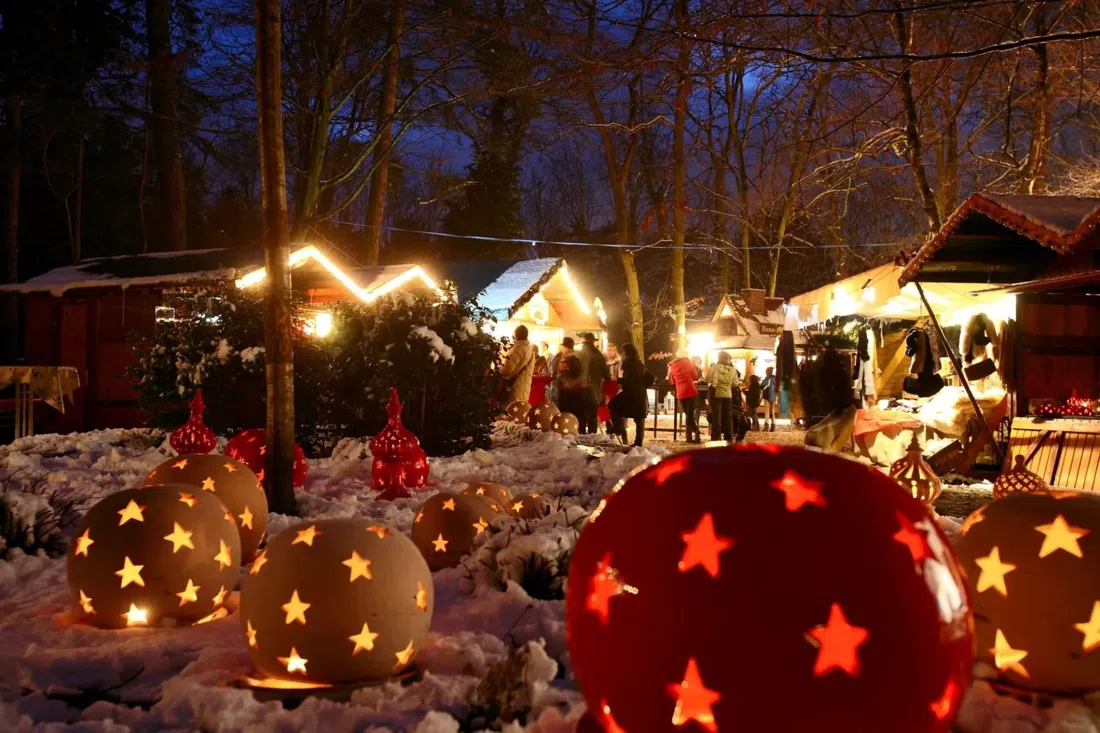
Getting there is tram 15 or 16 plus a ten-minute walk through unlit woodland, so wear shoes you can walk a forest path in rather than the ones you wore to dinner. There are no reservations. On a Friday or Saturday, arrive before 18:00 or you will be standing with your cup balanced on a fence post.
Höchster Weihnachtsmarkt (Justinusplatz and Schlossplatz, Höchst) has the best backdrop in the whole city and the shortest run of any market in this guide: one weekend only, 28 and 29 November 2026. Höchst is a medieval old town with a castle on the square, and the market is run by around fifty local associations rather than concessionaires, which is why the Glühwein is homemade and priced like charity rather than tourism at €3.50 to €5. The money stays in the district.
Two caveats. The lanes are narrow and get dense from mid-afternoon, so a group of ten will be walking in single file by 16:00. And recent bridge construction has kept the knights' camp in the castle moat off the programme, so if that is the thing you were travelling for, check before you commit the day to it.
Glühwein at skyline height
City Christmas Market & CityAlm (Innenstadt, lift up from Carl-Theodor-Reiffenstein-Platz, or drive to parking level 5) is the summer CityBeach rooftop reskinned as an après-ski terrace, and it is the only place in the city where you drink your Glühwein at eye level with the towers instead of craning up at them. Entry is free, drinks run €5 to €9, and it stays open later than Römerberg does, which makes it the natural second stop of an evening rather than a competing first one.

This is also the strongest group option in the centre. The open roof deck handles walk-up groups without drama, and the CityAlm hut itself takes company and private Christmas parties by arrangement, so a team of twenty has somewhere to actually sit down.
Skyline Winterzauber (Skyline Plaza roof garden, west of the centre) is Germany's highest ice rink and an unusual piece of engineering: the surface is synthetic eco-ice that uses no water, no electricity and no CO₂, so it stays skateable through the mild, wet Decembers this corner of the Rhine-Main plain specialises in, when conventional rinks turn to slush. Skating is around €6 for adults and €4 for children per hour, plus skate hire, and it runs from early November to mid-January, a longer season than any market in the city.
If you are organising for a group, this is the booking to make. Six ice-stock lanes take up to ten players each for head-to-head rounds of what is essentially curling with handles, and the lanes are bookable separately from general skating. Skates and learning aids are hired on site, so nobody needs to own anything.
A Christmas market that floats
Frankfurter Weihnachtsboot (Freigut and MAIN TERRASSE, moored on the Main) solves the calendar problem. It opens in early November and runs past Christmas, so it covers both shoulder ends of the season: the fortnight before the city market opens, and the dead week after 22 December, when Römerberg is a square full of empty cobbles again. Boarding is free; mulled wine and hot Aperol are €6 to €9, and food plates run €12 to €20.
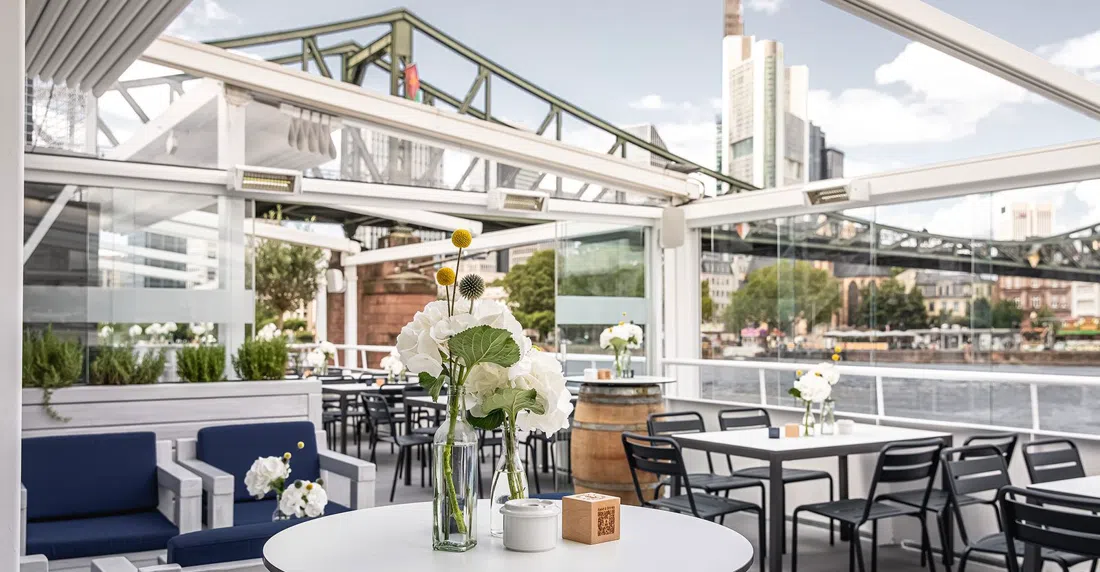
Deck space is finite in a way that a public square is not, so anything above about eight people should book ahead through Freigut, which also operates a bookable pop-up restaurant on board if you want the evening to include a sit-down meal. The photographs never convey the wind: the open deck is fully exposed, and what comes down the river is real. The sheltered lower deck is where people actually end up sitting.
The markets that argue with Römerberg
Massif Central Marché de Noël (Bethmannhof courtyard, Altstadt) is three minutes' walk from Römerberg and belongs to a different planet. An artist collective holds the courtyard of Frankfurt's oldest private bank and pours hot Äppler, the local apple wine, served warm and sharper than Glühwein, alongside the usual mulled wine, at €4 to €6 a cup. Reibekuchen, the fried potato pancakes, and bratwurst run €4 to €7. Entry is free, medium groups are no trouble, and the collective takes enquiries for private use of the courtyard spaces. Check the calendar before you walk over: it opens Thursday to Saturday only.

Winter Space (Jürgen-Ponto-Platz, Bahnhofsviertel) is the sharpest counter-programme in the city: Peruvian, Venezuelan and Colombian kitchens, social initiatives and urban beats, run by a local creative agency, open from midday until 22:00. Food and drinks are €4 to €10. There are workshops and childcare slots running alongside the bars, which is rare for an open-air winter site. It is free, loose and fine for groups.
Be straight with yourself about the setting. The Bahnhofsviertel is lively and scruffy in equal measure, and it is a district that reads very differently in company than it does alone at 22:30. Go with people, and take a tram or a short ride back rather than wandering.
Glögg and princesstårta for one weekend only
Schwedischer Weihnachtsmarkt (Schwedische Kirche, An der Wolfsweide, Preungesheim) opens for the first Advent weekend and nothing else, which in 2026 means 28 and 29 November. The reason to make the trip is the list of things you cannot buy at Römerberg: proper glögg at €3 to €4, princesstårta and other baked goods from €2 to €5, and Swedish handicraft sold by the people who made it rather than by a stall agent.
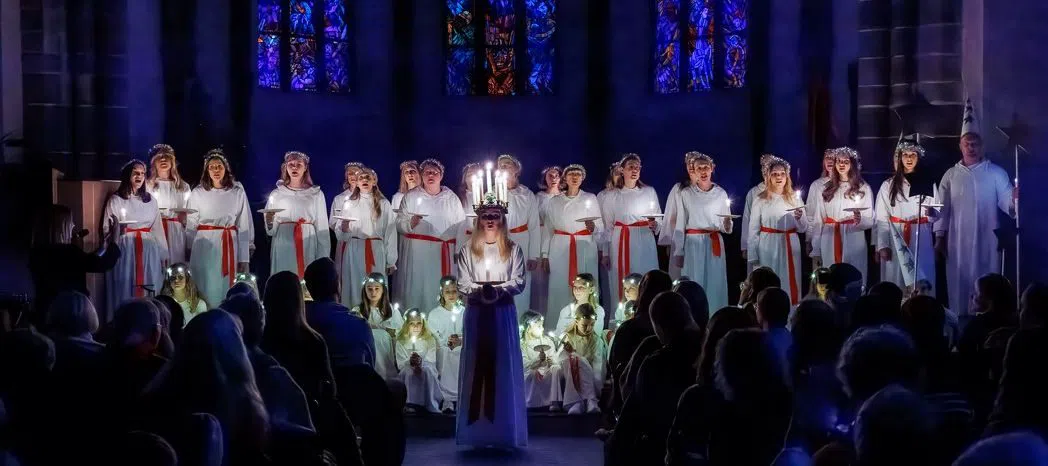
It is a small indoor hall run by the congregation. Entry is free and there is no booking, which works beautifully for four people and badly for twenty, since a coach party would fill the room. Preungesheim is out beyond the ring, so this is a deliberate journey rather than something you stumble into. It also collides exactly with the Höchst weekend: if you want both, do Höchst on the Saturday and the church hall on the Sunday, and accept that you will spend a fair chunk of the day on the S-Bahn.
What stays lit after the markets pack up
Winterlichter im Palmengarten (Westend) is not a market at all: an hour-long illuminated walk through a botanical garden, and the single best thing to do in Frankfurt in winter if you have brought a camera. Tickets are around €11 for adults and €5 concessions online, €13 and €6 at the gate, and they are timed and capacity-limited, so a group has to book the same slot together in advance. The walk-up remainder sells out on weekends.

The value is in the calendar. It carries the season past the markets into mid-January, so a trip in the first week of January still has a centrepiece. Dress for standing still rather than for walking, because you will stop constantly, and remember that last admission is an hour before closing, which catches out people who plan to arrive late after dinner.
Who should book what
For couples, the strongest evening is Massif Central for hot Äppler, then the roof at CityAlm for the skyline, skipping Römerberg between 17:00 and 21:00 entirely. For families, it is the Goetheturm woodland in the afternoon and the Mainkai craft huts on a separate day. For a group of eight or more, only three places here are genuinely built for you: the ice-stock lanes at Skyline Winterzauber, the CityAlm hut, and the lower deck of the Weihnachtsboot. All three want notice. Everything else is free, open-air and unreservable, which cuts both ways.
If you are deciding where to sleep, the centre puts you inside the six-square market but also inside the noise; Sachsenhausen is quieter, walkable to the river and better for the woodland market. Compare both on the Frankfurt hotel search before the first Advent weekend, which is the tightest night of the season for rooms.
Transport, cash and timing
One day ticket on the RMV network covers the whole spread, which matters because these places are not clustered: tram 15 or 16 for the Goetheturm, S-Bahn to Höchst station plus about ten minutes on foot, U-Bahn to Hauptwache for the central squares, and the Westend stops for the Palmengarten. Buy tickets in the app rather than queuing at a machine in the cold.
Carry cash. Many huts take cards now, but mug deposits, charity stalls and the volunteer-run bars at Höchst are frequently coin-only, and a dead card reader at a single hut is a solved problem if you have €20 in notes in a pocket. Budget roughly €25 to €35 a head for an evening of three Glühwein and something fried, and €15 or so on top if you are adding skating or the light trail.
On timing: the only week when everything overlaps is 23 to 29 November 2026, when the city market, the woodland market, Höchst, the Swedish hall, the boat and both rooftops are all running at once. It is also the busiest. If you would rather have space than completeness, come in the second week of December for the markets, or the first week of January for the light trail and the ice rink with almost nobody else in the way. More on the city across the rest of the year is in the Frankfurt guide.